


Australia’s Mother and Babies Report
Statistics that support families to be well informed before entering into the maternity care system.
Finding the Report
You can find the national report by searching “AIHW Australia’s Mothers and Babies.” NSW Health publishes its own detailed report online. Each state health department hosts its perinatal statistics publicly. They are not hidden — just rarely read by families.
- Australian Mothers and Babies Report Summary – click here »
- Australian Mothers and Babies NSW Report – click here »
Why is the report always 2 years behind?
The report is always about two years behind because of the way perinatal data is collected and validated. Every birth generates detailed clinical data. That information is submitted to state perinatal data collections, checked for accuracy, linked with other health datasets, analysed, and then published. The lag is administrative, not secretive. It simply reflects the time required to ensure national data integrity.
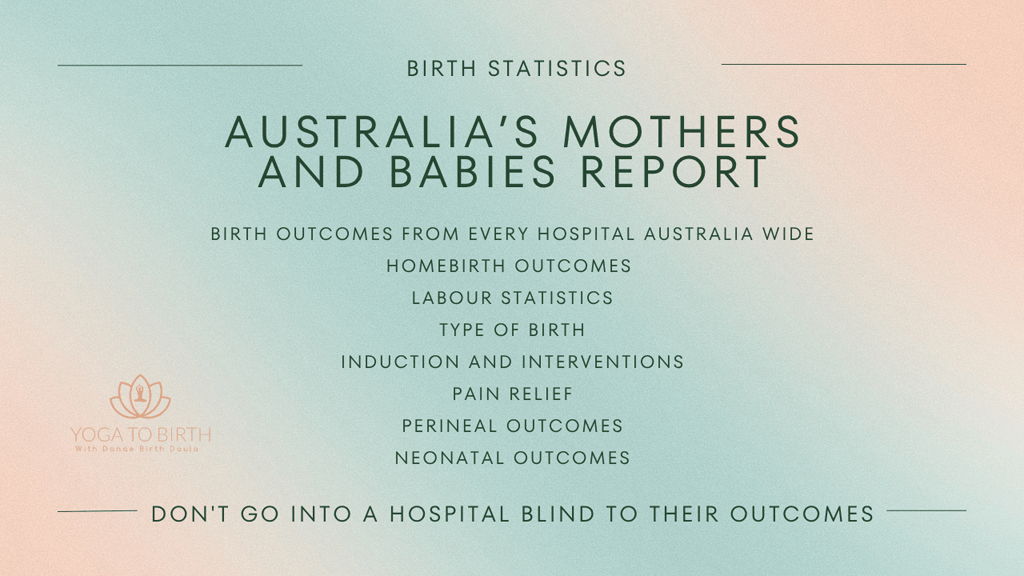
Australia’s Mothers and Babies Report
When families begin thinking about birth, most step into the maternity system assuming all hospitals offer roughly the same care. They do not. The patterns of intervention, the culture of each unit, and the outcomes they routinely achieve vary more than most people realise. That is where the Australian Mothers and Babies data becomes quietly powerful.
Most families never read it. That’s a mistake.
Each year, the Australian Institute of Health and Welfare publishes Australia’s Mothers and Babies. It compiles data from every state and territory health department. In New South Wales, detailed breakdowns come from NSW Health’s Mothers and Babies Report. Similar datasets are published by Queensland Health, the Victorian Perinatal Data Collection, SA Health, WA Health, ACT Health and the NT Department of Health. These reports include rates of induction, caesarean section, instrumental birth, epidural use, episiotomy, VBAC success, perineal trauma and neonatal outcomes. It does not tell you what should happen. It shows you what does happen.
These are not opinions, they are statistics, patterns. Patterns matter.
For example, national caesarean rates are 1 in 3 births overall. That number conceals enormous variation. Some large tertiary hospitals report primary caesarean rates well above 40%, while certain regional or continuity-of-care models are substantially lower. Private hospitals consistently report significantly higher caesarean rates than public midwifery-led models. In some private facilities caesarean rates exceed 50%. These is not a philosophical statements, they are statements of fact.
In NSW specifically, induction rates have climbed steadily over the past decade. Some metropolitan units induce more than 40% of women, compared with midwifery group practices where spontaneous labour rates remain significantly higher. Understanding those numbers reveals something important, you begin to see something important: the model of care predicts the pathway of birth.
All other states and territories Australia wide show similar patterns.
Hospitals do not print these patterns in brochures. They do not need to. The statistics speak.
These differences are not random. They reflect institutional culture, funding structures, staffing models, medico-legal environments and philosophical approaches to birth.
Understanding this before entering the maternity system changes everything.
If your goal is a low-intervention, physiological birth, then a hospital with a consistently high induction and caesarean profile may not align with that intention — even if the brochure emphasises “woman-centred care.” Statistics reveal behavioural trends more honestly than marketing language ever could.
Why does this matter?
Because informed consent requires understanding likely outcomes. If a hospital has a 45% caesarean rate, that pattern exists for reasons — policy, culture, staffing, risk thresholds. If you are seeking a low-intervention physiological birth, those patterns are not irrelevant.
I want a physiological birth
For women desiring normal physiological birth, including VBAC, homebirth consistently demonstrates the highest rates of spontaneous vaginal birth with the lowest intervention rates when appropriately screened and supported by experienced practitioners. That does not mean hospital birth is unsafe. It means the environment shapes physiology. Privacy, continuity, autonomy and undisturbed labour alter outcomes in measurable ways.
The data does not tell you what to choose. It tells you what typically happens.
Birth is not random. It follows patterns shaped by system design. Reading the Mothers and Babies reports before entering the maternity system allows families to choose their model of care with open eyes, aligned with the birth they hope to experience.
More on homebirth
Across Australia, planned homebirth for low-risk women consistently demonstrates very high rates of spontaneous vaginal birth and very low intervention rates. For women seeking normal physiological birth — including VBAC — homebirth remains statistically the most supportive environment when appropriately screened and attended by qualified providers. It removes many of the systemic drivers of intervention present in hospital settings.
This is not about ideology. It is about understanding systems.
Birth outcomes are shaped not only by biology, but by environment. The Australian Mothers and Babies data allows families to examine that environment with clear eyes.
NSW Families | @birthstats_NSW
The NSW Birth Stats Instagram page has taken the dense, multi-hundred-page NSW report and translated it into clear, visual comparisons between hospitals. Straight forward graphics of, spontaneous vaginal birth rates, primary caesarean rates, VBAC rates, epidural use — hospital by hospital.
That clarity is powerful.
When families can see that Hospital A has a 60% spontaneous vaginal birth rate while Hospital B has 42%, it reframes decision-making. When VBAC rates differ significantly between facilities, that becomes crucial information for women planning birth after caesarean. Transparency enables alignment between your birth preferences and the model of care most likely to support them.
Data is not destiny. Individual outcomes vary. But institutional patterns influence probabilities.
Informed decision making
Informed decision-making begins before labour starts. It begins with reading the numbers, understanding the patterns, and choosing the setting that aligns with the birth you are hoping to achieve.
When families combine official reports with accessible breakdowns like NSW Birth Stats, they move from passive entry into the maternity system to active participation in it. And that shift — from assumption to informed awareness — may be one of the most important birth preparations of all.
Prenatal Information
Become a member and gain access to Danae’s prenatal yoga classes, birth preparation and birth rehearsal resources.

six membership options
Upon purchase log back into the platform and navigate to the area you have purchased access too.
